A good home office does not need to be expensive or look like a showroom. The most important decisions are practical: where you place the desk, how you position the monitor, how much natural light you get, how you sit, and whether you can change position during the day.
Someone who spends eight hours writing will have different needs from someone who spends most of the day on video calls, designing, coding, or working with spreadsheets. The best setup is the one that supports the work you actually do.
Start With Natural Light
If you have a choice about where to put your desk, consider the available daylight before worrying about decoration.
A 2014 study by Mohamed Boubekri and colleagues compared office workers in workplaces with and without windows. Workers with windows received more light during the workweek and had longer sleep duration and better scores on some measures of vitality and sleep quality.
A later study by Boubekri and colleagues involving 30 knowledge workers compared two similar office environments with different daylight and view conditions. Participants in the optimized daylight and views environment slept an average of 37 minutes longer and scored 42% higher on a cognitive simulation designed to measure higher-order decision-making.
This does not mean that putting your desk beside a window will automatically make you more productive. It does suggest that daylight is worth considering when choosing between possible workspace locations.
If possible, position your desk so you can benefit from daylight without having direct sunlight or reflections hitting your screen.
Position Your Monitor Correctly
A badly positioned monitor can make even a good desk and chair uncomfortable.
The U.S. Occupational Safety and Health Administration (OSHA) recommends placing the monitor directly in front of you and at least 20 inches away. The top of the screen should be at or slightly below eye level, and the monitor should generally be positioned perpendicular to a window to reduce glare.
A practical setup is:
- Keep the monitor directly in front of you
- Position it roughly 20 to 40 inches from your eyes
- Keep the top of the screen at or slightly below eye level
- Avoid placing the screen directly in front of a bright window
- Adjust the screen position before buying additional equipment
If you work primarily on a laptop, raising the screen can create a second problem because the keyboard rises with it. A laptop stand combined with a separate keyboard and mouse can allow you to position the screen correctly while keeping your hands and wrists at a more comfortable height.
Choose a Chair for Adjustability, Not Appearance
A stylish chair is not necessarily a good work chair.
OSHA recommends a chair that supports the back, legs, buttocks, and arms and can be adjusted to fit the user. The chair should also work together with the height and position of the desk, monitor, and keyboard.
Look for a chair that allows you to:
- Support your back comfortably
- Keep your feet supported
- Adjust the seat height
- Change your sitting position during the day
- Keep your arms in a comfortable position while working
If you are buying a chair, try it before committing to an expensive model whenever possible. Adjustability is generally more useful than simply choosing a chair with the most features.
Keep the Keyboard and Mouse at a Comfortable Height
Your keyboard should allow you to work without constantly raising your shoulders or bending your wrists.
OSHA recommends keeping the keyboard directly in front of you, with your shoulders relaxed and your elbows close to your body. Your wrists should remain straight and aligned with your forearms.
Keep the mouse close enough that you do not have to repeatedly reach across the desk.
This is particularly important when using a laptop stand. Raising the screen while using the laptop's built-in keyboard can leave your hands too high, so a separate keyboard and mouse can help create a more comfortable working position.
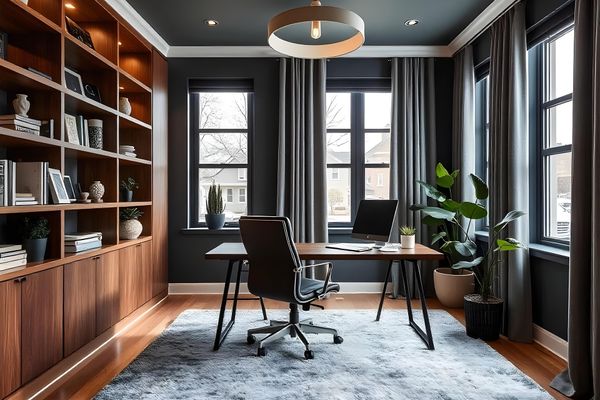
Do You Need a Standing Desk?
Not necessarily.
A sit-stand desk can be useful if it makes it easier to change positions throughout the workday, but you do not need to stand continuously.
A systematic review of 12 studies found that sit-stand desk interventions reduced full-day sedentary time by an average of 68.7 minutes per day after three months compared with control groups. Reductions were also found after six and 12 months.
The practical takeaway is that a sit-stand desk can give you another way to change position during the day. You might sit for focused work, stand during a short meeting, and switch positions when you start feeling uncomfortable.
If your budget is limited, a standing desk does not need to be your first purchase.
Fix Glare Before Buying a New Monitor
If you regularly squint at your screen or move your head to avoid reflections, you may have a lighting problem rather than a monitor problem.
OSHA recommends arranging lighting to minimize glare from windows, ceiling lights, and desk lamps. Excessive glare can make the screen harder to see and contribute to eyestrain and headaches.
Try changing the position of the desk or monitor first.
A useful arrangement is to place the screen at a right angle to the window rather than directly facing it or having the window immediately behind it.
If the room becomes darker later in the day, use a desk lamp that provides enough light for reading and writing without creating a reflection on the screen.
If You Have Limited Natural Light
Not every home has a room with a large window. A bedroom, basement, or interior room may have very little daylight.
In that situation, artificial lighting becomes more important.
A 2017 study by Mariana Figueiro and colleagues examined daytime light exposure among office workers in five buildings managed by the U.S. General Services Administration. The study found that greater morning exposure to circadian-effective light was associated with better sleep-related measures, while greater daytime exposure was also associated with better sleep quality and other measures of circadian alignment.
More recent research has also looked at artificial task lighting. A 2025 study by Juntae Jake Son examined 32 full-time employees working in windowless offices and compared LED and fluorescent task lighting over two one-week periods.
For a home office without much daylight, the practical goal is not to recreate sunlight artificially. Instead, use adjustable, comfortable lighting and avoid having a bright light source directly reflected in your screen.
Make a Small Workspace Work
You do not need a separate room to create a functional home office.
If you work from a bedroom, living room, or dining area, create a defined work zone with enough space for the equipment you actually use.
A compact setup might include:
- A desk with enough depth for your monitor and keyboard
- An adjustable chair
- A monitor or laptop stand
- A separate keyboard and mouse if needed
- A desk lamp
- Basic cable management
The goal is to make the work area functional without allowing it to take over the entire room.
If possible, create a simple end-of-day routine. Closing the laptop, putting away work equipment, or leaving the workspace can help create a clearer separation between work and personal time.
Keep the Desk Functional
You do not need a completely empty desk. The important thing is that frequently used items have a permanent place.
Keep your monitor, keyboard, mouse, and other daily essentials within easy reach. Store chargers, cables, documents, and stationery when you are not using them.
This reduces the amount of time you spend moving things around before you can start working and makes a small workspace easier to maintain.
Design the Workspace Around Your Job
The best home office setup depends partly on what you actually do.
If you spend most of the day on video calls, prioritize:
- Good lighting in front of you
- Reliable audio
- A camera positioned at a comfortable height
- A background that does not create distractions
If you spend most of the day writing, prioritize:
- Keyboard comfort
- Screen position
- A quiet environment
- Enough desk space
If you work with large spreadsheets, designs, or code, a larger monitor or additional display may be more useful than decorative upgrades.
The important question is not "What does the perfect home office look like?" but "What equipment and layout will make my actual work easier?"
Your workspace is only one part of a successful remote career. If you're looking for your next opportunity, your resume matters too. Learn how to build a remote resume that gets noticed in 2026.
A Simple Home Office Reset
You can improve your workspace without buying anything.
1. Move the Desk
Choose the position with the best combination of daylight, privacy, and low glare.
2. Fix the Screen
Place your main monitor directly in front of you and adjust its height and distance. OSHA recommends at least 20 inches of viewing distance, with the top of the screen at or slightly below eye level.
3. Check Your Chair
Make sure your back and feet are supported and that you are not leaning forward to see the screen.
4. Check Your Keyboard
Keep your shoulders relaxed and your wrists reasonably straight while typing.
5. Deal With Glare
Move the monitor, adjust blinds, or reposition your lamp before buying a new screen.
6. Remove Unnecessary Items
Keep frequently used equipment within easy reach and move everything else into storage.
7. Create an End-of-Day Routine
Close the laptop, put away work materials, or leave the workspace when your working day ends.
What to Prioritize If Your Budget Is Limited
You do not need to buy everything at once.
If you have a limited budget, prioritize the things that affect how you work most directly:
1. Positioning — It is free and can immediately improve your setup.
2. Chair — Support and adjustability matter during a long workday.
3. Screen height — A laptop stand or external monitor can solve a common positioning problem.
4. Keyboard and mouse — Especially useful if you raise a laptop screen.
5. Lighting — Improve daylight and reduce glare before buying decorative lighting.
6. Storage — Add it when clutter starts interfering with your work.
7. Decoration — Personalize the space after the fundamentals are working.
You can create a much better workspace without buying expensive equipment. Start with positioning, lighting, ergonomics, and the equipment you actually need for your job. Once those basics work, add upgrades based on a specific problem rather than buying accessories simply because they are marketed for home offices.
Ready to put your new home office to work? Explore remote opportunities on Online.jobs and find a role that fits your skills and work style.
Sources
- U.S. Occupational Safety and Health Administration (OSHA) — Computer Workstations
- Mohamed Boubekri et al. — Impact of Windows and Daylight Exposure on Overall Health and Sleep Quality of Office Workers: A Case-Control Pilot Study
- Mariana G. Figueiro et al. — The Impact of Daytime Light Exposures on Sleep and Mood in Office Workers
- Juntae Jake Son — Effects of LED Versus Fluorescent Task Lighting on Sleep Quality and Daytime Function in Windowless Office Environments
- PubMed — Sit-Stand Desk Systematic Review